
kVA to kW
Need to convert kVA to kW? Our free KVA to KW Calculator is a simple and accurate online tool that helps you instantly convert apparent power (kVA) to real power (kW). Whether you are working with generators, motors, UPS systems, or electrical installations, this kVA to kW converter gives you fast and reliable results.
Whether you are an electrician, generator technician, engineer, or business owner, this powerful kVA to kW converter tool helps you get instant and accurate results.
The standard formula for conversion.
kW = kVA × Power Factor
Our online tool automatically applies this formula so you don’t have to do manual calculations.
Convert kVA to kW
Convert apparent power to real power
0.8 is the standard default for generators and motors. Purely resistive loads — heaters, incandescent lighting — run close to 1.0.
How to Convert kVA to kW
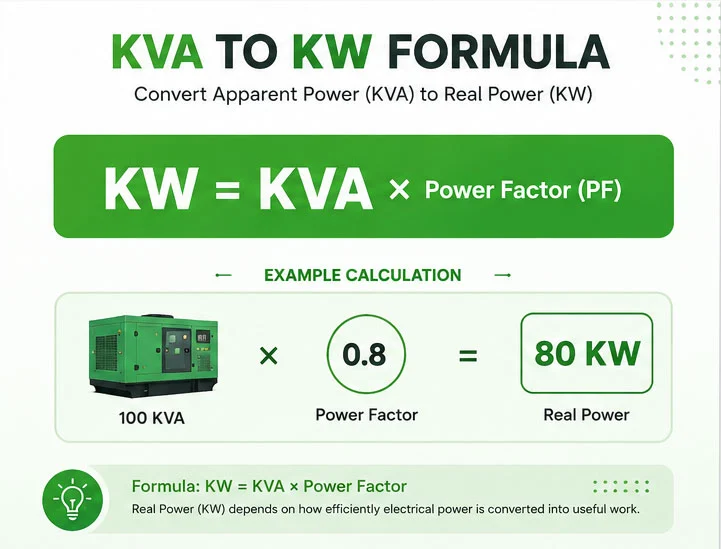
The kVA to kW formula is:
kW = kVA × Power Factor
For example:
- 100 kVA × 0.8 = 80 kW
- 500 kVA × 0.8 = 400 kW
- 1000 kVA × 0.8 = 800 kW
Our kVA to kW conversion calculator performs this calculation automatically, helping you save time and avoid manual errors.
What Is the Difference Between kVA and kW?
Many people ask, “Is kVA equal to kW?”
The answer is No.
- kVA (Kilovolt-Amperes) measures the apparent power in an electrical system.
- kW (Kilowatts) measures the real or usable power that actually performs work.
The difference between them depends on the power factor (PF). If the power factor is 1.0, then 1 kVA equals 1 kW. In most industrial applications, generators operate at a power factor of 0.8.
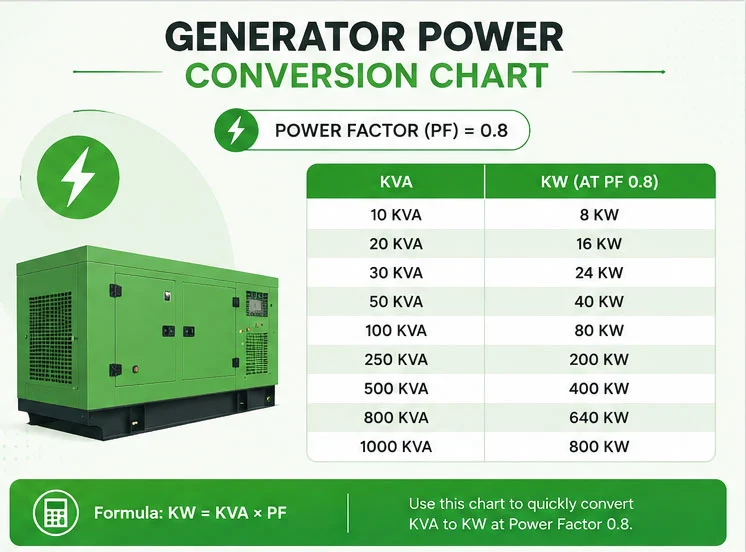
Common kVA to kW Conversions
The following examples assume a 0.8 power factor, which is standard for most diesel generators.
These values may change if a different power factor is used.
| kVA | kW (Power Factor 0.8) |
|---|---|
| 1 kVA | 0.8 kW |
| 3.5 kVA | 2.8 kW |
| 5 kVA | 4 kW |
| 10 kVA | 8 kW |
| 15 kVA | 12 kW |
| 20 kVA | 16 kW |
| 30 kVA | 24 kW |
| 35 kVA | 28 kW |
| 100 kVA | 80 kW |
| 800 kVA | 640 kW |
| 1000 kVA | 800 kW |
| 1600 kVA | 1280 kW |
kVA to kW Conversion Chart
| Apparent Power (kVA) | Power Factor | Real Power (kW) |
|---|---|---|
| 50 | 0.8 | 40 |
| 75 | 0.8 | 60 |
| 100 | 0.8 | 80 |
| 125 | 0.8 | 100 |
| 150 | 0.8 | 120 |
| 200 | 0.8 | 160 |
| 250 | 0.8 | 200 |
| 300 | 0.8 | 240 |
| 400 | 0.8 | 320 |
| 500 | 0.8 | 400 |
| 750 | 0.8 | 600 |
| 1000 | 0.8 | 800 |
Why Power Factor Matters
Power factor is the ratio between real power and apparent power. It determines how efficiently electrical power is converted into useful work.
A higher power factor means less energy is wasted and the difference between kVA and kW becomes smaller.
Typical power factors include:
- Residential loads: 0.95–1.0
- Commercial buildings: 0.9
- Industrial machinery: 0.8
- Diesel generators: 0.8 (standard rating)
Always use the correct power factor when performing kVA to kW conversion for accurate results.
Where Is kVA to kW Conversion Used?
Converting from kVA to kW is important in many electrical applications, including:
- Diesel generator sizing
- Generator load calculations
- Electrical panel design
- Industrial power systems
- UPS capacity calculations
- Motor load estimation
- Construction power planning
- Data centers and critical facilities
Understanding the relationship between kVA and kW helps engineers, electricians, contractors, and facility managers select the right equipment for their power requirements.
Frequently Asked Questions
Is kVA equal to kW?
No. kVA and kW are different electrical measurements. They become equal only when the power factor is 1.0.
What is the formula to convert kVA to kW?
The formula is:
kW = kVA × Power Factor
How do I convert 100 kVA to kW?
Using a power factor of 0.8:
100 × 0.8 = 80 kW
How many kW is 10 kVA?
At a power factor of 0.8:
10 kVA = 8 kW
How many kW is 1000 kVA?
At a power factor of 0.8:
1000 kVA = 800 kW
Why do generators use kVA instead of kW?
Generators are rated in kVA because their capacity depends on both voltage and current, regardless of the connected load's power factor. The actual kW output varies according to the power factor.
Can I convert kVA to kW without knowing the power factor?
No. The power factor is required because kW depends on both the apparent power (kVA) and the efficiency of the electrical load.
Use Our Free kVA to kW Converter Online
Our kVA to kW calculator is designed for electricians, engineers, contractors, facility managers, and generator users who need quick and accurate power conversions. Simply enter the kVA value and power factor to instantly convert kVA to kW without manual calculations.
Whether you’re selecting a generator, planning an electrical installation, or checking equipment ratings, this calculator provides reliable results in seconds.